
If you've ever searched for SEO pricing, you probably got more confused than when you started. Some agencies charge $500 a month. Others want $5,000 or more. And then there are those "$99 SEO packages" that sound too good to be true — because they are.
So how much does SEO cost in the USA, really?
The short answer: it depends. SEO isn't a fixed-price product. It's a service that adapts to your business, your competition, and your goals. Pricing varies based on multiple factors, and understanding those factors is the first step to making a smart decision.
This guide gives you a clear, honest breakdown of SEO costs for small businesses in the USA. No vague ranges. No sales pitch. Just the numbers and the context you need to decide what makes sense for your business.
What Determines SEO Pricing in the USA?
Before looking at specific numbers, it helps to understand why prices vary so much. Four major factors drive the cost of any SEO engagement.

Business Size and Competition
A local plumber competing in a single city faces a very different SEO landscape than a SaaS company targeting customers nationwide. Local SEO requires less content, fewer backlinks, and a narrower keyword strategy. National or multi-location SEO demands significantly more resources.
The more competitive your market, the bigger your budget needs to be. If ten other businesses are already investing heavily in SEO for the same keywords, you'll need to match — or exceed — that effort to gain visibility.
Industry Difficulty
Not all industries are created equal when it comes to SEO. Legal services, finance, insurance, and healthcare are among the most competitive (and expensive) niches to rank in. The keywords are high-value, which means more businesses are fighting for them.
On the other hand, niche local services — think specialty repair shops, local tutoring, or regional landscaping — tend to have lower competition and require a smaller investment to see meaningful results.
Current Website Condition
Your website's starting point matters. A site with a solid technical foundation, clean code, fast load times, and an SEO-friendly website structure requires less upfront work than one plagued by broken links, missing meta tags, slow performance, and poor mobile experience.
If your site needs a technical overhaul before any content or link-building work can begin, expect higher costs in the first few months. Think of it as fixing the foundation before building the house.
Goals and Timeline
Want results in three months? That's possible, but it requires an aggressive (and more expensive) approach. Willing to invest steadily over 12 months? You can spread the cost and build momentum gradually.
Quick wins demand bigger budgets. A long-term, sustainable strategy costs less per month but requires patience. Most small businesses benefit from a balanced approach — realistic timelines paired with consistent monthly investment.
Average SEO Costs for Small Businesses in the USA
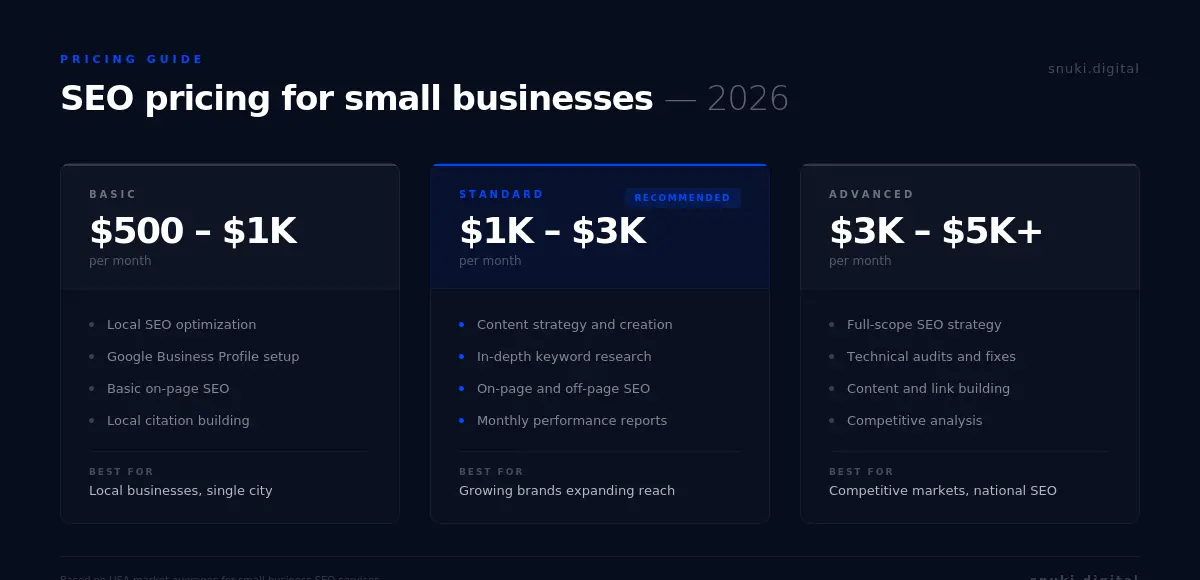
Here's where the numbers come in. These ranges reflect what small businesses in the USA typically pay in 2026.
| Level | Monthly Cost | What You Get |
|---|---|---|
| Basic | $500 – $1,000 | Local SEO, Google Business Profile optimization, basic on-page SEO, citation building |
| Standard | $1,000 – $3,000 | Content strategy, keyword research, on-page and off-page SEO, monthly reporting |
| Advanced | $3,000 – $5,000+ | Full SEO strategy, technical audits, content creation, link building, competitive analysis, detailed analytics |
Not sure what SEO should cost for your business? Get a free estimate.
Monthly SEO Pricing
Monthly retainers are the most common pricing model. You pay a set fee each month for ongoing SEO work — technical fixes, content creation, link building, and reporting.
This is the model most agencies recommend (and most small businesses prefer) because SEO is not a one-time task. It's an ongoing process. Rankings fluctuate. Competitors adjust their strategies. Google updates its algorithm. Continuous work keeps you moving forward instead of sliding back.
Hourly SEO Rates
Some consultants and agencies charge by the hour, typically between $75 and $200 per hour. This model works well for specific, scoped tasks like an SEO audit, a technical consultation, or a strategy session.
Hourly rates are less common for ongoing SEO work because costs can become unpredictable. But for a one-time expert opinion or a targeted fix, it's a practical option.
One-Time SEO Projects
Not every business needs a monthly retainer. Some need a one-time project — a full site audit, a website migration, or a technical cleanup. These projects typically range from $1,000 to $10,000 or more, depending on scope and complexity.
One-time projects work best when your site has a specific problem that needs solving, or when you're launching a new site and want to get the technical foundation right from the start.
SEO Pricing Models Explained
Understanding how agencies structure their pricing helps you evaluate proposals and avoid surprises.
Monthly Retainer
The retainer model gives you a dedicated team (or specialist) working on your SEO every month. You get consistent progress, regular reports, and a long-term strategy that evolves as your business grows.
This is the best option for businesses serious about growth. SEO compounds over time — the work done in month one supports results in month six and beyond.
Project-Based SEO
Project-based pricing covers a defined scope of work with a clear start and end. Common projects include technical audits, site migrations, content overhauls, and website performance improvements.
This model works well when you know exactly what you need and want a fixed budget. Just make sure the deliverables are clearly defined before signing anything.
Performance-Based SEO
Some agencies offer performance-based pricing — you pay based on results (usually rankings or traffic). This sounds appealing, but it carries serious risks.
Agencies incentivized purely by rankings may cut corners. That can mean black-hat tactics, spammy link building, or targeting easy-to-rank but low-value keywords. These shortcuts might deliver short-term results, but they can lead to Google penalties that are expensive and time-consuming to recover from.
If an agency guarantees first-page rankings, treat that as a red flag, not a selling point.
Cheap SEO Packages (Red Flags)
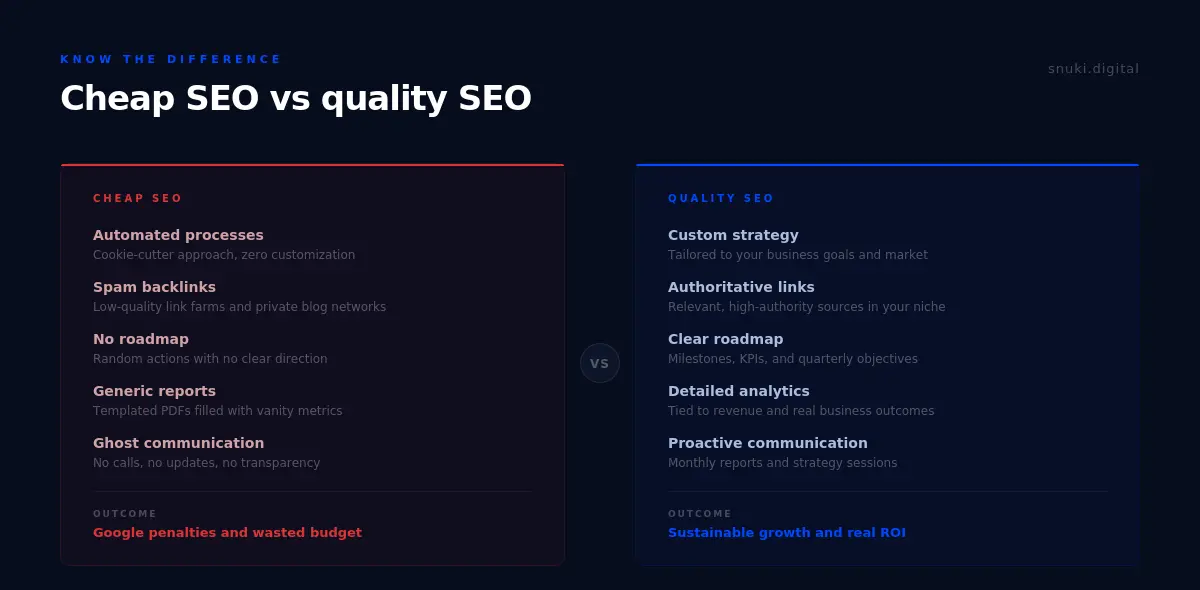
The "$99 SEO package" is one of the most persistent — and most damaging — traps in the industry. Here's what that money usually buys: automated submissions to low-quality directories, spammy backlinks from irrelevant sites, zero strategy, and a real risk of Google penalization.
Cheap SEO doesn't just waste money. It can actively harm your site. Recovering from a penalty costs far more than doing it right in the first place.
What Do You Actually Get for Your Money?
When you pay for quality SEO services, here's what that investment should include:
Technical SEO — site speed optimization, mobile responsiveness, crawlability fixes, structured data, and resolving indexing issues.
Keyword Research — identifying the search terms your customers actually use, analyzing competition, and mapping keywords to pages.
Content Creation — producing SEO content that ranks and converts. Blog posts, service pages, landing pages — all built around your keyword strategy.
Link Building — earning high-quality backlinks from relevant, authoritative websites. This is one of the most time-intensive (and valuable) parts of SEO.
Reporting and Analytics — monthly reports showing what was done, what changed, and what's planned next. Connected to tools like Google Search Console and platforms like Ahrefs for transparent, data-driven insights.
See what a real SEO strategy looks like for your business. Learn more.
Is SEO Worth the Cost for Small Businesses?
This is the real question. And the honest answer: for most small businesses, yes.
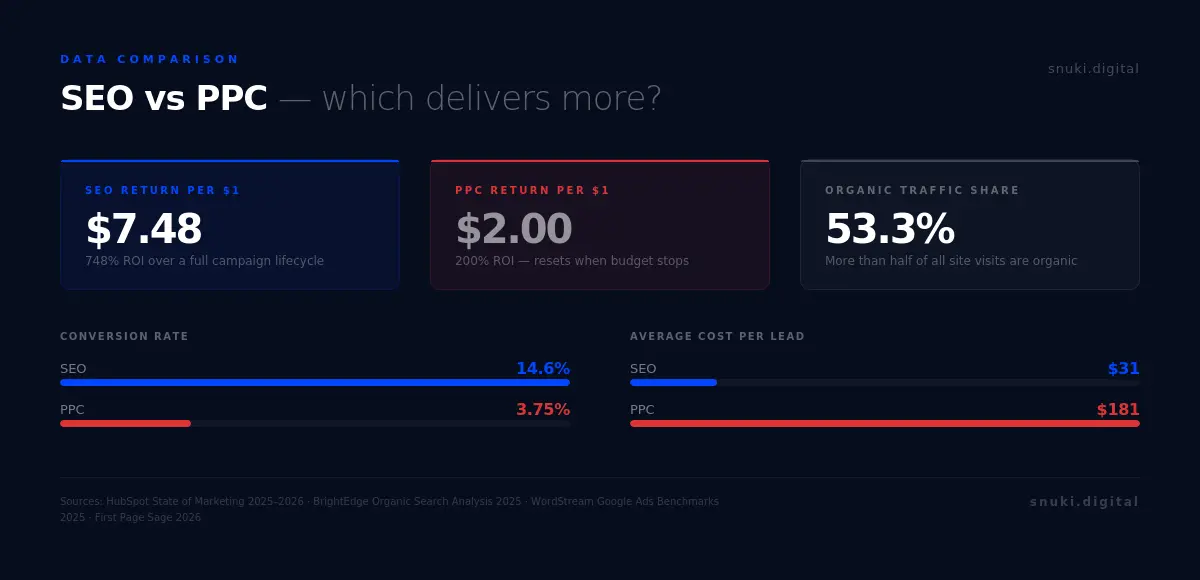
Here's why. Compare SEO to paid ads. With PPC (pay-per-click), you pay for every click. The moment you stop paying, the traffic stops. SEO works differently. The traffic you earn through organic rankings doesn't cost you per visit, and it doesn't disappear overnight when you pause your campaign.
SEO builds equity in your online presence. A well-optimized page can generate traffic for months or years after it's published. Over time, the cost per lead from SEO drops significantly compared to paid channels.
That said, SEO is not instant. It typically takes three to six months to start seeing meaningful results, and 12 months or more to reach full potential. If you need leads tomorrow, a digital marketing strategy that combines paid ads with SEO gives you both short-term results and long-term growth.
The businesses that get the most value from SEO are those that commit to it as a long-term investment, not a one-month experiment.
How to Choose the Right SEO Agency in the USA
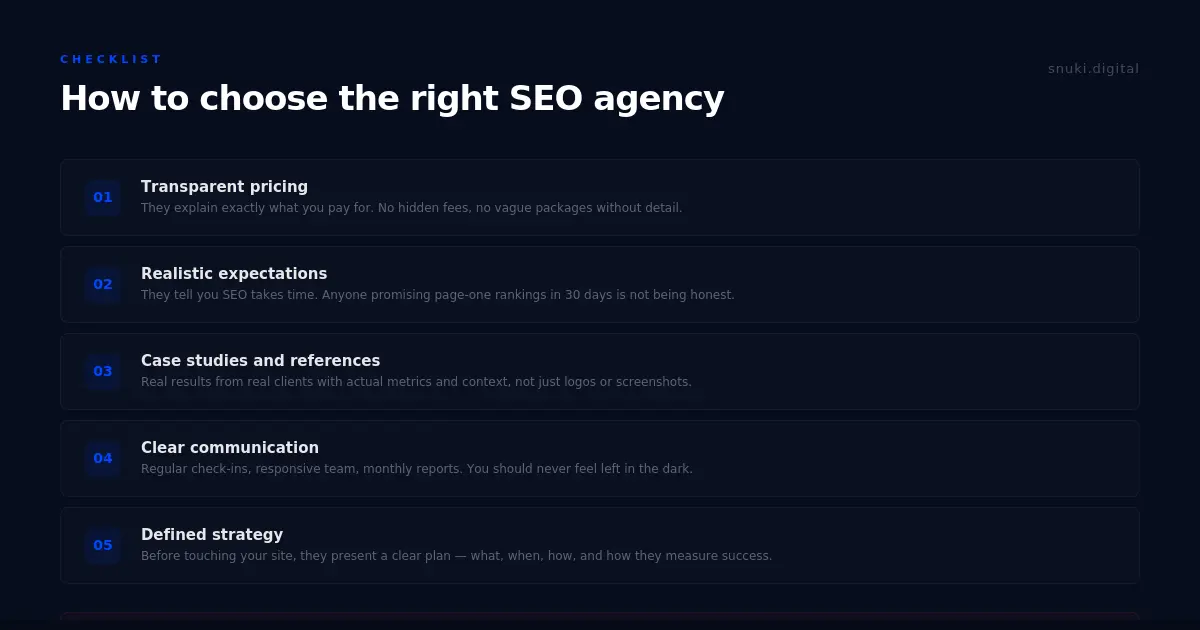
Choosing an agency is one of the most important decisions you'll make. A good agency accelerates your growth. A bad one wastes your budget — or worse, damages your site. Use this checklist:
-
Transparent pricing — They explain exactly what you're paying for. No hidden fees, no vague "SEO packages."
-
Realistic expectations — They tell you SEO takes time. Anyone promising instant results is either lying or using tactics that will hurt you later.
-
Case studies and references — They can show you real results from real clients. Not just screenshots — actual examples with context.
-
Clear communication — They respond to your questions. They schedule regular check-ins. You never feel like you're in the dark.
-
Defined strategy — Before they touch your site, they present a clear plan. You know what they'll do, when they'll do it, and how they'll measure success.
If an agency can't check all five boxes, keep looking. Your budget deserves better.
How Much Should YOU Budget for SEO?
Every business is different. But here's a practical starting framework:
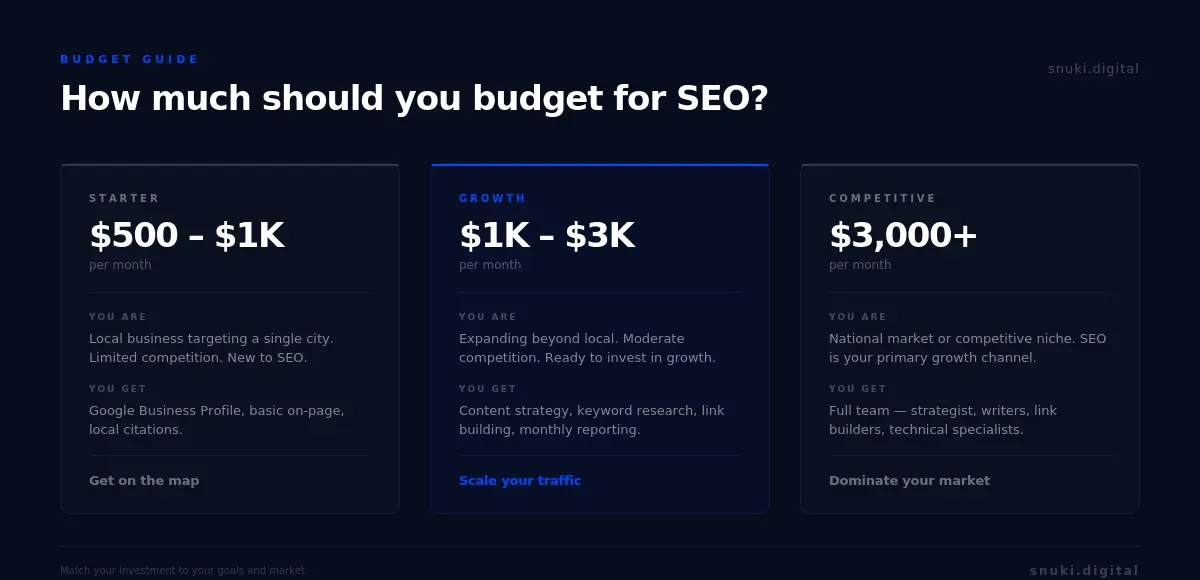
You're a local business targeting a single city or region. Competition is moderate. You need foundational SEO: Google Business Profile optimization, basic on-page work, and local citations. This is your starting point if you're new to SEO.
You want to expand beyond your immediate area or start competing for more valuable keywords. This budget supports content creation, link building, and a more comprehensive strategy. Best for businesses ready to invest in steady, measurable growth.
You're in a competitive industry or targeting national keywords. You need a full team — strategist, content writers, link builders, and technical specialists. This level of investment is for businesses that see SEO as a primary growth channel.
Quick guide:
- Local business, limited competition → start at the Starter level
- Growing business, expanding reach → invest at the Growth level
- Competitive market, aggressive goals → commit to the Competitive level
The right budget is the one that matches your goals and your market. Start where it makes sense, measure results, and scale from there.
Frequently Asked Questions
Most small businesses pay between $500 and $5,000 per month, depending on their goals, industry, and competition level. Local SEO sits at the lower end, while national or competitive strategies require a larger investment.
It can be — for basic local SEO. At this budget, expect foundational work like Google Business Profile optimization, on-page improvements, and local citation building. It won't support a full content strategy or aggressive link building, but it's a solid starting point for local businesses with limited competition.
SEO involves multiple disciplines: technical optimization, content creation, link building, keyword research, and ongoing analysis. Quality work requires skilled professionals and consistent effort over months. The cost reflects the expertise and time required to deliver lasting results.
Most businesses start seeing initial improvements within three to six months. Significant, sustainable results typically take 6 to 12 months. The timeline depends on your starting point, competition, and how aggressively you invest.
You can handle some basics — like optimizing your Google Business Profile, writing quality content, and fixing obvious technical issues. But advanced technical SEO, competitive keyword strategy, and link building usually require professional expertise. If you want to understand the fundamentals, start with SEO basics and build from there.
A comprehensive SEO engagement typically includes technical audits, keyword research, on-page optimization, content creation, link building, and monthly reporting. The specific deliverables depend on the package and the agency. Always ask for a detailed scope of work before committing.
Almost never. Cheap SEO typically relies on automated processes and low-quality link building that can lead to Google penalties. Recovering from those penalties is far more expensive than investing in quality professional SEO services from the start.
Ready to build an SEO plan that actually fits your budget and goals?
Book a Free Strategy Call